

Living in Baka, Jerusalem — The Complete Neighborhood Guide for Olim (2026)


If you are researching Jerusalem neighborhoods and want the combination of authentic Israeli character, an established Anglo community, beautiful stone architecture, and a genuinely walkable urban lifestyle — Baka belongs at the top of your list. This is not a sanitized Anglo bubble. It is one of Jerusalem's most layered and beloved neighborhoods, and it happens to have one of the highest concentrations of English-speaking Olim in the entire country.
So — is Baka a good place to live for Olim in 2026? For families, young couples, and anyone who wants to be rooted in one of Jerusalem's most established Anglo communities — the answer is yes.

Living in Baka Jerusalem — What Kind of Neighborhood Is It?
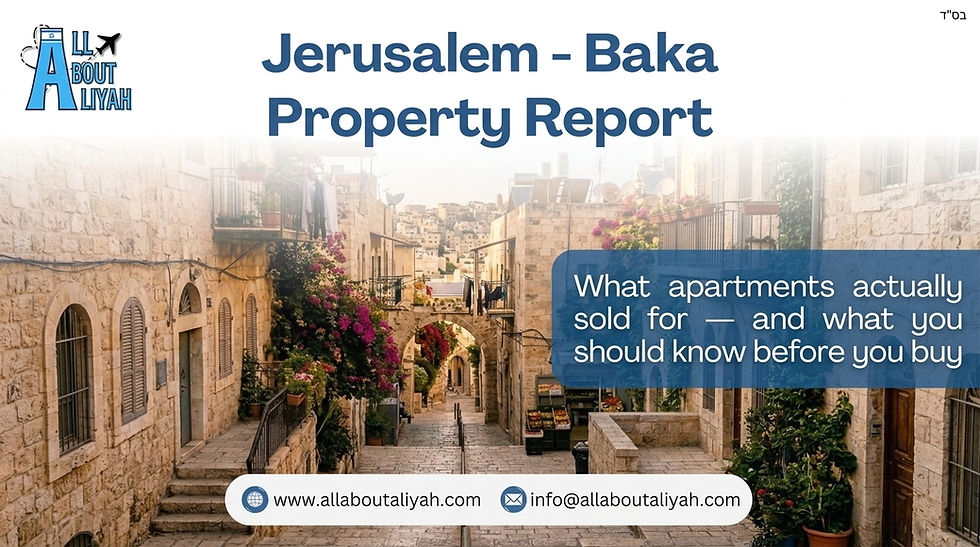
Baka (בקעה — Arabic for 'valley,' alluding to the Valley of Refaim that runs along its western border) sits in southern Jerusalem — bounded by the German Colony to the north and Talpiot to the south. Its official Israeli name is Geulim (גאולים — meaning 'redemption') — the name given after 1948 when new immigrants, primarily from Morocco, were settled into the neighborhood's stone homes and felt redeemed from the bonds of the Diaspora. Nobody actually uses it. On road signs you will see Geulim. Everywhere else it is Baka.
The neighborhood was established in 1892 alongside the completion of the Jerusalem–Jaffa railway. Many of its original Arab-built stone homes survived the War of Independence intact — and it is those beautiful old limestone buildings, alongside newer renovated and rebuilt apartments, that give Baka its distinct character today.
Baka has a population of approximately 10,000 residents — a genuine mix of religious and secular Jews, Ashkenazi and Sephardi backgrounds, Israelis and immigrants. Approximately 60% of residents are religious — primarily Dati Leumi or national religious — and relations between the observant and secular residents are positive and respectful. French speakers are also well-represented alongside the Anglo community.
A piece of Aliyah history: Ulpan Etzion — Israel's very first Hebrew language school — was established in Baka in 1949. The first Olim to ever learn Hebrew in a structured ulpan did so right here in this neighborhood. For an Oleh arriving in Baka today, that history is worth knowing.
What you will actually notice living here: Shabbat is lively. The cafes on Derech Beit Lechem (דרך בית לחם) are packed on Friday mornings. The Train Track Park (פארק המסילה — Park HaMesila) — the longest bike path in Jerusalem — runs along Derech HaRekevet (דרך הרכבת) on the western edge of the neighborhood and is one of the city's major recreation areas.
The First Station (התחנה — HaTachana) complex — a beautifully restored 19th-century railway building turned cultural and dining hub — is a short walk from most of Baka.
Tip 1: About to start Ulpan? Click here to read our complete guide to free Ulpan for Olim in Israel — including the history of Ulpan Etzion, your 18-month entitlement, and how to register before your window runs out.
Tip 2: Thinking about Jerusalem more broadly? Read our complete guide — Is Jerusalem a Good Place to Live for Olim? — for the full city picture before diving into specific neighborhoods.
The Anglo & Olim Community in Baka
About a quarter of Baka's residents were born in the United States and other English-speaking countries. This is not a new community — Anglo families have been rooted here for decades. That history matters: it means established institutions — shuls, schools, community programs — neighbors who understand the Oleh experience firsthand, and a social fabric that makes integration feel less overwhelming.
The community spans the full spectrum — Modern Orthodox to Dati Leumi to traditional to completely secular. Young couples, families with children, professionals, and academics all find their place here. Baka and the German Colony are probably the most iconic Anglo neighborhoods in southern Jerusalem — long-time favorites thanks to their strong Modern Orthodox presence, vibrant cultural scene, and convenient access to schools, synagogues, shops, and public transportation.
Tip: Connect with the Baka Anglo community through Facebook before you arrive — search 'Baka Jerusalem Anglo' or 'Jerusalem Anglo Community.' The established community here is warm and genuinely welcoming to new Olim.
Shuls in Baka for English Speakers
Baka has an unusually rich shul scene for a neighborhood its size.
Kehilat Nitzanim
A vibrant Dati Leumi community in the heart of Baka, led by Rav Shai Finkelstein. Nitzanim maintains daily minyanim, a full weekly shiur schedule, and a busy Shabbat calendar — including a Minyan Tze'irim (מניין צעירים) for younger adults and age-specific children's tefillah groups. It is the anchor of community life for many Anglo families in Baka.
Website: kehilatnitzanim.org
Kehilat Yedidya
A 150-family Modern Orthodox congregation founded in 1980 by British and American immigrants, located on Lifshitz Street. Yedidya is known for its warm and intellectually engaged character and is concerned with both traditional Jewish values and civic engagement. The community regularly welcomes non-Jewish visitors and interfaith groups — reflecting the confident, open spirit of Baka's Anglo community.
Website: https://yedidya.org.il/
The Yael Shul
One of Baka's most iconic institutions — a Religious Zionist synagogue that has been part of the neighborhood since the early years of the state. A major renovation in 2000 completely transformed the building and its courtyard. Located on Yael Street (רחוב יעל).
Website: https://www.yael.org.il/
Chabad of Baka — Beit Levi
Led by Rabbi Avraham Hendel, Chabad of Baka serves the neighborhood's diverse international community — including a large percentage of English and French speakers. Weekly Shabbat services and meals, Torah classes, and holiday programming throughout the year. A welcoming landing point for Olim of all backgrounds.
Website: chabadofbaka.info
Tip: In Baka the shul you choose will largely shape your social world — visit on a Shabbat and daven at several communities before deciding where to live.
Real Estate in Baka — What You Can Expect to Pay
Baka is one of Jerusalem's prestige addresses and prices reflect that. New construction commands between ₪55,000 and ₪75,000+ per square meter. But for Olim who want to be in a proven, stable Anglo community in the heart of the capital — Baka has delivered consistent long-term value.
Actual Confirmed Transactions — Nadlan, May 2026
New construction (2025 builds):
Apartment | Sold Price |
74 sqm / 3-room | ₪4.54M (₪61,310/sqm) |
103 sqm / 4-room | ₪5.84M (₪56,728/sqm) |
Older secondhand stock:
Apartment | Sold Price |
55 sqm / 3-room (1970 building, 6th floor) | ₪2.09M (₪37,909/sqm) |
44 sqm / 3-room, Derech Beit Lechem | ₪2.46M |
62 sqm / 3-room, HaPalmach Street | ₪2.85M |
Average rent: approximately ₪7,800/month — Madlan 2026 data
Why Prices Stay High?
While Tel Aviv saw price softening through 2025, Jerusalem prices continued to climb — the average 4-room apartment in Jerusalem rose by 8.9% to approximately ₪3.36 million citywide.
Baka sits well above the city average, driven by chronic inventory shortages and consistent Anglo demand. Geographic and preservation constraints keep new supply tight.
Important Note for Buyers — Mamad & Miklat
Baka has a large stock of pre-1948 limestone buildings. These are beautiful — but many will not have a Mamad (ממ"ד — safe room). Every apartment built after 1992 is required by law to include a Mamad. For older buildings, ask specifically about the building's shared Miklat (מקלט — communal shelter) before signing anything.
Tip: Before committing to any property in Baka, spend 15 minutes on Nadlan.gov.il and check what units on that specific street have actually sold for. Individual streets in Baka can vary significantly — knowing the real data puts you in a much stronger negotiating position. Click here to read our complete guide to checking real estate prices in Israel using Nadlan.
Getting Around From Baka
Buses
Several Egged bus lines connect Baka to the city center and Jerusalem Central Bus Station via Derech Beit Lechem and surrounding streets. Check current routes and schedules on Moovit or the Ministry of Transportation's journey planner — routes and numbers are updated periodically.
Light Rail — Blue Line (Coming)
A new light rail Blue Line is currently under construction — 24 kilometers, 40 stations, expected to serve 250,000 passengers daily. The line will run from Ramot in the north to Gilo in the south, with a section along Emek Refaim Street (רחוב עמק רפאים) — just west of Baka — that will significantly improve connectivity for the neighborhood. Construction began in September 2025 and the line is expected to open gradually between 2029 and 2031.
Train to Tel Aviv
For intercity travel, Jerusalem's Yitzhak Navon underground station is accessible from Baka by bus. The direct high-speed train to Tel Aviv takes approximately 32-34 minutes — including a stop at Ben Gurion Airport. Check schedules at rail.co.il.
On Foot & by Bike
The Train Track Park (פארק המסילה) runs the full western length of Baka — the longest bike path in Jerusalem. You can walk or cycle to the German Colony, First Station, and beyond with ease.
Tip: New to getting around Israel? Read our complete guide to Public Transportation in Israel — buses, trains, the Rav Kav card, and how to pay.
Schools in Baka
All schools in the neighborhood operate under the Jerusalem Municipality network.
Efrata Elementary School
2 Gad Street. A progressive religious public elementary school serving Baka, Talpiot, and the Katamonim. Efrata integrates traditional Jewish studies with arts, music, and drama — and has a long-standing program to include children with special needs in mainstream classrooms. One of Baka's flagship elementary schools with a well-established Anglo-friendly reputation.
Website: Efrata
Geulim Alef Elementary School
4 Kibbutz Galuyot Street. A secular public elementary school serving children in Baka and Talpiot, with a community-focused ethos and a long history of neighborhood involvement.
Website: Geulim
Oranim Elementary School
Also serves the Baka area. Verify current enrollment details and catchment through the Jerusalem Municipality website.
Pelech — Religious Experimental High School for Girls
Widely considered one of the top high schools in Israel — Pelech (grades 7-12, approximately 400 students) is located in Baka and pioneered the teaching of Talmud to girls alongside arts, sciences, women's studies, and civic education. It is a semi-private school, partially supported by the Ministry of Education, and has a strong Anglo-connected tradition.
Website: pelech.org.il
Tip: Every Oleh child in Israel is legally entitled to supplemental Hebrew language support hours at school (שעות שפה). When visiting schools, ask specifically about their שעות שפה program for Olim and how many new immigrant children are currently enrolled. Click here to read our complete guide to free Ulpan for Olim — your 18-month entitlement starts the day you land.
Healthcare — Kupot Cholim Near Baka
All four Kupot Cholim (קופות חולים) operate branches in the Baka and southern Jerusalem area. For Anglo Olim in Jerusalem, Meuhedet and Maccabi are the most popular choices — both are known for English-speaking staff and strong digital tools.
Health Fund | Good to Know | Website |
Maccabi (מכבי) | Popular with Anglos in Jerusalem; modern app; English support | |
Meuhedet (מאוחדת) | Also popular with Jerusalem Anglos; known for shorter wait times | |
Clalit (כללית) | Largest network in Israel | |
Leumit (לאומית) | Smaller network, often praised for personal service |
Major hospitals serving Jerusalem:
Hospital | Notes |
Hadassah Medical Center (הדסה) | Ein Kerem and Mount Scopus campuses — primary hospital serving Jerusalem residents |
Shaare Zedek Medical Center (שערי צדק) | Centrally located, highly regarded |
Tip: Not sure which Kupat Cholim to choose? Click here to read our complete guide to Kupat Cholim in Israel — comparing all four health funds across cost, coverage, and English-language support.
The Security Question
Baka is a well-established central residential neighborhood — not a border zone. Day-to-day security concerns here are no different from any urban environment.
For your apartment specifically:
Built after 1992:
Should include a Mamad (ממ"ד — fortified safe room). Confirm before signing.
Older building (pre-1992):
Ask about the building's shared Miklat (מקלט). Most older Baka buildings have one.
Download the Pikud HaOref (פיקוד העורף) app before or immediately after moving in — it gives real-time alerts and shows nearby shelter locations.
Who Is Baka Right For?
Profile | Fit |
Modern Orthodox / Dati Leumi Anglo family | Excellent — shuls, schools, and community are all well-established |
Secular Anglo Oleh | Good — genuinely mixed neighborhood |
Young Anglo couple | Great — vibrant, walkable, active social scene |
Family with children | Strong — multiple schools, parks, community infrastructure |
Budget-conscious Oleh | Challenging — one of Jerusalem's pricier neighborhoods |
Looking for new construction | Limited — new builds exist but at a significant premium |
Retiree seeking a calm Anglo community | Very good — walkable, established, quieter streets |
Frequently Asked Questions (FAQ)
Q: Is Baka safe?
A: Yes — it is a long-established central neighborhood with no specific elevated security concerns. Standard urban awareness applies.
Q: Is Baka expensive?
A: By Jerusalem standards, yes — it is a premium address. New apartments run ₪55,000-₪75,000+ per sqm. If budget is a constraint, neighboring Arnona and New Katamon offer a similar community feel at more accessible prices.
Q: Is Baka more religious or secular?
A: Both. Approximately 60% of residents are religious — primarily Dati Leumi — but the neighborhood is genuinely mixed. Shomer Shabbat and secular families live side by side with positive and respectful relations.
Q: Is the Anglo community growing?
A: Yes. New Katamon — within walking distance of Baka — is actively being developed as an additional Anglo hub, with new shul infrastructure and housing projects under way.
Q: What are typical rents in Baka?
A: Around ₪7,800/month on average — Madlan 2026 data. Desirable units move quickly — use Yad2 and Facebook Anglo Jerusalem housing groups to monitor listings. Click here to read our guide on How to Use Yad2 to find apartments in Israel.
Q: Do apartments in Baka have Mamads?
A: Only apartments built after 1992 are legally required to have one. Baka has a large stock of pre-1948 limestone buildings — beautiful but without Mamads. Always ask about the building's communal Miklat (מקלט) before signing anything on an older property.
Q: How do I get to Tel Aviv from Baka?
A: Take a bus to Jerusalem Yitzhak Navon underground station — then the high-speed train to Tel Aviv in approximately 32-34 minutes including a stop at Ben Gurion Airport. Check schedules at rail.co.il.
Final Tip — Check Real Baka Prices Before You Decide
Don't rely on estimates. Baka has its own micro-market and individual streets can vary significantly. Before renting or buying, pull actual transaction data on Nadlan.gov.il for the specific addresses you are considering.
Knowing the real sold prices — not just asking prices — is the single most important thing you can do before any real estate decision in Israel. It costs nothing and takes 15 minutes.
Click here to read our complete guide to checking real estate prices in Israel using Nadlan.




Comments